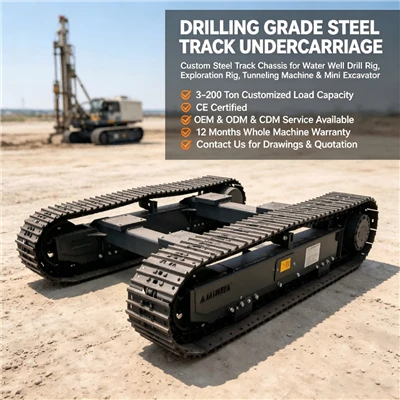

Noise levels associated with a drill track undercarriage are a crucial aspect of the operation of drilling equipment. As a supplier of Drill Track Undercarriage, we understand the significance of addressing the noise factor and how it impacts various stakeholders, including operators, nearby communities, and the overall environment.
Understanding the Sources of Noise in Drill Track Undercarriages
The drill track undercarriage is a complex system that comprises several components working in tandem. Each of these components can contribute to the overall noise levels. The tracks themselves, which are in constant contact with the ground, generate noise as they move. The friction between the track links and the ground surface, along with the impact of the track on uneven terrain, can result in significant noise emissions.
Another major source of noise is the drive system of the undercarriage. The motors, gears, and other moving parts in the drive mechanism produce vibrations and mechanical noise. These components are under high stress during the operation of the drill rig, and the resulting noise can be quite loud. The hydraulic systems also play a role in generating noise. The flow of hydraulic fluid through hoses and valves, as well as the operation of hydraulic pumps, can create a distinct humming or buzzing sound.
Measuring Noise Levels
To accurately assess the noise levels associated with a drill track undercarriage, specialized equipment is used. Sound level meters are commonly employed to measure the intensity of the noise in decibels (dB). These meters are calibrated to provide accurate readings of the sound pressure levels at different frequencies.
When measuring the noise levels of a drill track undercarriage, it is important to consider several factors. The measurement should be taken at a specific distance from the undercarriage, typically at a standard distance of one meter. The background noise level in the area should also be measured to ensure that the readings are not affected by external sources of noise.
In addition to the overall sound pressure level, the frequency spectrum of the noise is also analyzed. Different frequencies of noise can have different effects on human hearing and the environment. High - frequency noise, for example, is often more annoying and can cause more damage to hearing over time compared to low - frequency noise.
Impact of Noise on Operators
Exposure to high noise levels can have serious consequences for the operators of drill rigs with track undercarriages. Prolonged exposure to noise above 85 dB can lead to noise - induced hearing loss. This is a permanent condition that can significantly affect the quality of life of the operators.
In addition to hearing loss, high noise levels can also cause other health problems. It can lead to stress, fatigue, and reduced concentration. Operators who are exposed to excessive noise may have difficulty communicating with each other, which can pose a safety risk on the job site. To mitigate these risks, operators are often provided with personal protective equipment (PPE) such as earplugs and earmuffs.
Impact on the Surrounding Environment
The noise generated by drill track undercarriages can also have an impact on the surrounding environment. In industrial areas, the noise can disrupt the normal activities of nearby businesses and workers. In residential areas, it can cause annoyance to the local population and may even violate noise regulations.
Noise pollution can also affect wildlife. Many animals are sensitive to noise, and the loud sounds from drill track undercarriages can disrupt their natural behavior, such as feeding, mating, and migration. This can have long - term consequences for the ecological balance in the area.
Strategies to Reduce Noise Levels
As a Drill Track Undercarriage supplier, we are committed to developing solutions to reduce the noise levels associated with our products. One approach is to improve the design of the undercarriage components. For example, using advanced materials for the track links can reduce the friction between the tracks and the ground, thereby decreasing the noise generated during movement.
The drive system can also be optimized to reduce noise. This can involve using quieter motors and gears, as well as implementing vibration - damping techniques. Hydraulic systems can be designed with noise - reducing features such as mufflers and low - noise valves.
Another strategy is to use enclosures and barriers to reduce the spread of noise. These can be installed around the undercarriage or other noisy components of the drill rig. Enclosures can be made of sound - absorbing materials that can significantly reduce the noise levels in the surrounding area.
Noise Regulations and Standards
There are various regulations and standards in place to control the noise levels generated by industrial equipment, including drill track undercarriages. These regulations are designed to protect the health and safety of workers, as well as the well - being of the general public.


In many countries, there are specific limits on the noise levels that industrial equipment can produce. For example, in the European Union, the Machinery Directive sets out requirements for the noise emission of machinery. Manufacturers are required to ensure that their products comply with these standards before they can be sold in the market.
The Role of Technology in Noise Reduction
Advancements in technology are playing an increasingly important role in reducing the noise levels associated with drill track undercarriages. For example, the use of computer - aided design (CAD) and simulation software allows manufacturers to optimize the design of undercarriage components for reduced noise.
New materials, such as composite materials, are being developed that can offer improved noise - damping properties. These materials can be used in the construction of track links, drive components, and hydraulic hoses to reduce noise emissions.
Our Product Range and Noise Levels
At our company, we offer a wide range of Drill Rig Undercarriage products, including Underground Drill Rig Undercarriage, Tracked Undercarriage for Drill Rig, and Crawler Undercarriage for Rotary Drilling Rig. We are continuously working on improving the design and performance of these products to reduce their noise levels.
Our R & D team is dedicated to researching and implementing the latest technologies and materials to achieve the goal of quieter undercarriages. We also conduct regular noise testing on our products to ensure that they meet or exceed the relevant noise regulations and standards.
Conclusion
In conclusion, the noise levels associated with a drill track undercarriage are a significant concern for the industry. The noise can have a negative impact on operators, the surrounding environment, and may also lead to compliance issues with noise regulations. As a Drill Track Undercarriage supplier, we recognize the importance of addressing this issue.
We are committed to providing our customers with high - quality undercarriage products that not only offer excellent performance but also minimize noise emissions. If you are in the market for drill track undercarriage products, we invite you to contact us for further discussion and to explore how our products can meet your needs while also reducing the impact of noise.
References
- Noise Control Engineering Handbook, by Cyril M. Harris.
- Industrial Noise: Assessment and Control, by David A. Bies and Colin H. Hansen.
- Machinery Directive 2006/42/EC of the European Parliament and of the Council.