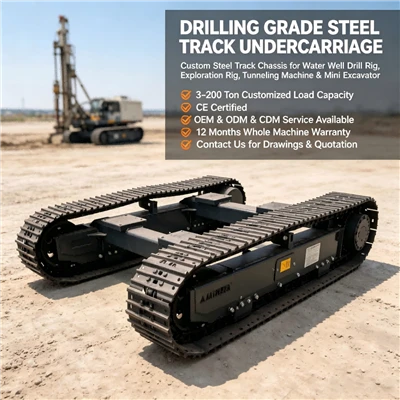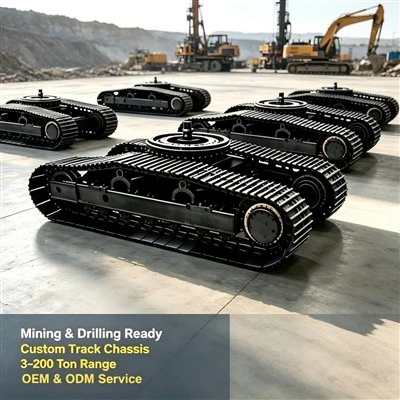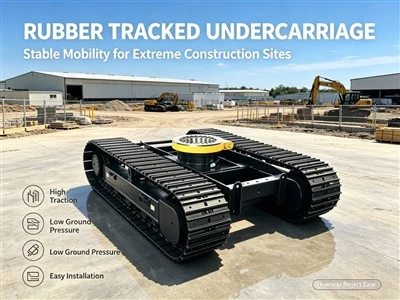

Tracked drill rigs are indispensable in various industries, from mining and construction to geological exploration. The chassis of a tracked drill rig serves as the foundation that supports the entire drilling equipment, enabling it to move across challenging terrains. As a supplier of tracked drill rig chassis, I have gained in - depth knowledge of its main components. In this blog, I will explore these components in detail to provide a comprehensive understanding of the tracked drill rig chassis.
1. Track Assembly
The track assembly is one of the most visible and crucial components of a tracked drill rig chassis. It is responsible for enabling the drill rig to move forward, backward, and turn. The track assembly consists of several sub - components:
Track Links
Track links are the individual segments that make up the continuous track. They are typically made of high - strength steel to withstand the heavy loads and harsh operating conditions. These links are connected to each other with pins and bushings, forming a flexible chain - like structure that wraps around the drive sprocket, idlers, and rollers. The design and material of the track links determine the durability and traction of the drill rig. For example, some track links are designed with special profiles to increase grip on soft or uneven ground. You can find high - quality track links in our Crusher Crawler Track Frame Assembly.
Drive Sprocket
The drive sprocket is a toothed wheel that engages with the track links to transmit power from the engine to the tracks. It is usually connected to the transmission system of the drill rig. The teeth of the drive sprocket are precisely designed to fit the track links, ensuring smooth and efficient power transfer. A well - designed drive sprocket can reduce wear on the track links and improve the overall performance of the drill rig.
Idlers
Idlers are located at the front and rear of the track assembly. Their main function is to guide the track and maintain proper tension. They help to keep the track in alignment and prevent it from derailing. Idlers are usually mounted on bearings and can rotate freely. They also play a role in absorbing shock and vibration, which can extend the lifespan of the track assembly.
Track Rollers
Track rollers are distributed along the lower part of the track assembly. They support the weight of the drill rig and allow the track to roll smoothly. The number and size of track rollers depend on the size and weight of the drill rig. High - quality track rollers are designed to withstand heavy loads and resist wear, ensuring a long service life.
2. Undercarriage Frame
The undercarriage frame is the structural backbone of the tracked drill rig chassis. It provides a rigid support for all other components of the chassis, including the track assembly, engine, and drilling equipment.
Main Frame
The main frame is the largest and most important part of the undercarriage frame. It is usually made of welded steel plates or structural sections. The main frame is designed to withstand the heavy loads and dynamic forces generated during the operation of the drill rig. It also provides mounting points for the track assembly, engine, and other components. The design of the main frame takes into account factors such as weight distribution, stability, and ease of maintenance.
Cross - Members
Cross - members are used to connect the main frame and provide additional support and rigidity. They help to distribute the loads evenly across the main frame and prevent it from twisting or bending. Cross - members are typically made of steel and are welded or bolted to the main frame.
3. Suspension System
The suspension system of a tracked drill rig chassis plays a vital role in providing a smooth ride and protecting the equipment from shock and vibration.
Spring - Type Suspension
Some tracked drill rigs use a spring - type suspension system. In this system, springs are used to absorb the shock and vibration generated by the uneven terrain. The springs are usually mounted between the track rollers and the undercarriage frame. They can compress and expand to adapt to the changes in the terrain, providing a more comfortable and stable operation for the drill rig.
Hydraulic Suspension
Hydraulic suspension systems are becoming increasingly popular in modern tracked drill rigs. These systems use hydraulic cylinders to adjust the height and stiffness of the suspension. Hydraulic suspension can provide better control over the ride quality and can be adjusted according to the specific operating conditions. For example, in rough terrain, the suspension can be set to a higher stiffness to improve stability, while in smooth terrain, it can be set to a lower stiffness for a more comfortable ride.
4. Steering System
The steering system of a tracked drill rig chassis allows the operator to control the direction of the drill rig.
Differential Steering
Differential steering is the most common steering method used in tracked drill rigs. In a differential steering system, the speed of the tracks on each side of the drill rig can be independently controlled. By increasing the speed of one track and decreasing the speed of the other, the drill rig can turn. This method provides good maneuverability and is suitable for a wide range of operating conditions.
Brake - Based Steering
Some drill rigs use a brake - based steering system. In this system, the brakes on one side of the drill rig are applied to slow down or stop the corresponding track, while the other track continues to move. This causes the drill rig to turn. Brake - based steering is relatively simple and cost - effective, but it may not provide as precise control as differential steering.
5. Power Transmission System
The power transmission system is responsible for transferring the power from the engine to the tracks and other components of the drill rig.
Transmission
The transmission is a key component of the power transmission system. It allows the operator to change the speed and torque of the drill rig according to the operating requirements. There are different types of transmissions, such as manual transmissions, automatic transmissions, and hydro - mechanical transmissions. Each type has its own advantages and disadvantages, and the choice of transmission depends on factors such as the size of the drill rig, the operating conditions, and the operator's preferences.
Drive Shafts
Drive shafts are used to transmit power from the transmission to the drive sprockets. They are usually made of high - strength steel and are designed to withstand high torque and rotational speeds. Drive shafts need to be properly balanced and aligned to ensure smooth power transfer and prevent vibration and noise.


Conclusion
In conclusion, a tracked drill rig chassis consists of several key components, each of which plays an important role in the overall performance and functionality of the drill rig. The track assembly provides mobility, the undercarriage frame offers structural support, the suspension system ensures a smooth ride, the steering system enables directional control, and the power transmission system transfers power efficiently.
As a supplier of tracked drill rig chassis, we are committed to providing high - quality components that meet the strictest standards of performance and durability. Our products, such as the Exploration Drill Crawler Undercarriage, Complete Undercarriage Assembly for Exploration Drill Rig, Steel Track Undercarriage for Exploration Drill Rig, and Tracked Undercarriage for Exploration Drill Rig, are designed to enhance the reliability and efficiency of your drill rigs.
If you are in the market for a tracked drill rig chassis or its components, we invite you to contact us for more information. Our team of experts is ready to assist you in finding the best solutions for your specific needs. Engage in a procurement discussion with us, and let's work together to ensure the success of your projects.
References
- Smith, J. (2018). Tracked Vehicle Technology. Engineering Press.
- Davis, R. (2020). Drilling Equipment Handbook. Mining and Construction Publishing.
- Brown, T. (2019). Chassis Design and Optimization for Heavy - Duty Vehicles. Vehicle Engineering Journal.