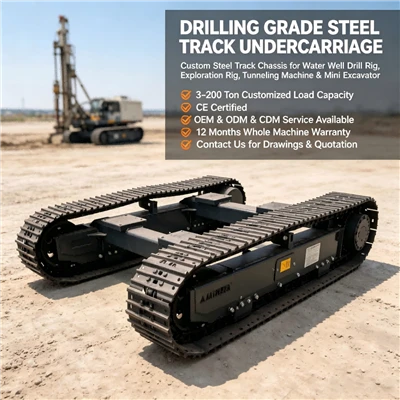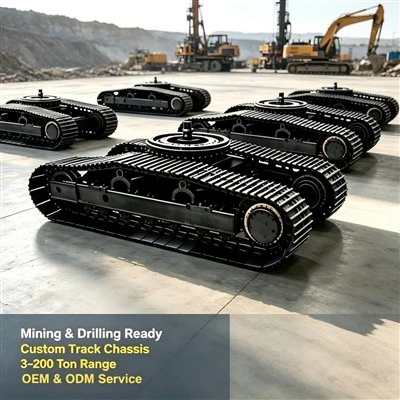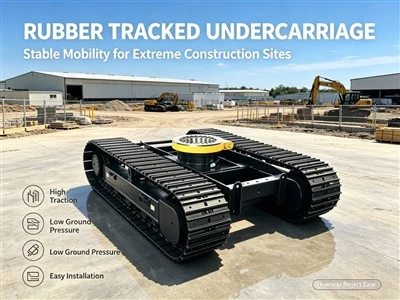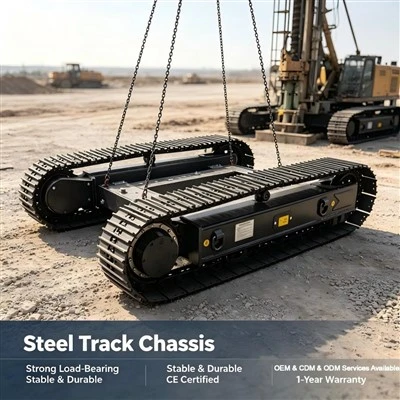

Xinjiang, as an important engineering machinery industrial base in my country, has seen rapid development in the production of steel tracked chassis in recent years. Its products are widely used in agricultural machinery, mining equipment, and special vehicles, offering advantages such as wear resistance, impact resistance, and low ground pressure. Today, we'll explore the key aspects and technical characteristics of steel tracked chassis production in Xinjiang.
Material Selection is Fundamental: The core components of a steel tracked chassis include track plates, drive wheels, and track rollers. These components require high strength and wear resistance. Local Xinjiang companies typically use high-strength alloy steel materials, such as Q690D and 45MnB, and enhance their mechanical properties through rigorous heat treatment processes (such as tempering). Some high-end products also employ wear-resistant welding technology, depositing tungsten carbide alloy onto the track plate surface to extend service life.
Precision Machining Ensures Quality: The machining precision of the tracked chassis directly affects the operational stability of the equipment. Currently, most enterprises in Xinjiang use CNC machining centers to process key components such as track plates and drive wheels. Through high-precision boring and milling, gear hobbing, and other processes, they ensure that the clearance between components is controlled within 0.1mm. For example, the tooth profile machining error of the drive wheel must be less than 0.05mm to avoid abnormal noise and vibration during operation.
Welding processes enhance reliability. The welding quality of the tracked chassis is crucial, especially the connection between the track frame and the track plates. Enterprises in Xinjiang generally use CO₂ gas shielded welding and submerged arc welding technologies, strictly controlling the current, voltage, and welding speed during the welding process. Some advanced production lines have also introduced robotic welding workstations, using programming to achieve uniformity and consistency in the weld seams, reducing human error.
Strict assembly and debugging standards. The assembly of the tracked chassis must follow strict process procedures, including adjusting the preload of the track links, installing the lubrication system of the support rollers, and calibrating the positioning of the guide wheels. During the debugging phase, the chassis undergoes load testing to simulate the stress distribution under actual working conditions, ensuring the reliability of each component under heavy loads and harsh environments. For example, some mines conduct 1,000-hour continuous loading tests on tracked chassis to verify their fatigue strength.