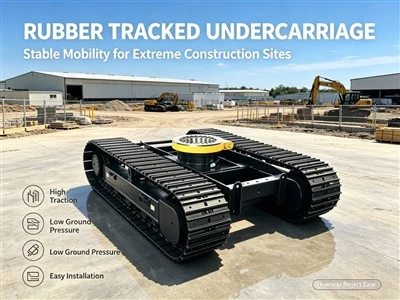

Many users consider the practicality of rubber-tracked chassis when choosing a chassis for construction machinery.
Outstanding Performance in Complex Terrain Operations
The core advantage of rubber-tracked chassis lies in their off-road capability. They can adapt to complex terrains such as mud, sand, and grass, are less prone to slipping than traditional steel tracks, and reduce damage to the ground. For example, in scenarios such as landscaping maintenance and farmland renovation, rubber-tracked chassis manufactured in Nanjing can easily handle soft ground without getting stuck or crushing crops.
Superior Advantages in Urban Construction
In urban construction, the quietness and low-damage characteristics of rubber-tracked chassis are highly valued. They operate with approximately 30% less noise than steel tracks and do not scratch the ground like steel tracks, making them widely used in scenarios such as residential area renovation and municipal engineering. However, it should be noted that rubber tracks are sensitive to sharp objects; avoid prolonged driving on roads with a lot of gravel.
Maintenance Costs and Lifespan Considerations
From a cost perspective, daily maintenance of rubber-tracked chassis is simpler, requiring no frequent lubrication of track pins. However, rubber tracks may harden in low temperatures and age easily in high temperatures, with a typical lifespan of 3000-5000 hours, depending on usage frequency and environment. In contrast, steel tracks are more resistant to extreme environments but are heavier.
Applicable Equipment Types Reference: Nanjing rubber track chassis are commonly used in small excavators, agricultural machinery, and inspection robots. For example, in 1-ton mini excavators, it balances flexibility and load-bearing capacity; while in large construction machinery, some manufacturers use a steel-rubber hybrid track design. Selection should be based on a comprehensive assessment of equipment weight and operating environment.
Overall, Nanjing rubber track chassis perform excellently in specific scenarios, especially suitable for users with high ground protection requirements and complex operating environments. If your equipment frequently operates on soft ground and you prioritize low noise and maintenance costs, this product is worth considering. Of course, for complex working conditions or extreme environments, it is recommended to use it in conjunction with other chassis types.